
Search Camillus Residents by Record
A useful Camillus residents directory search begins with a narrow question. For a current property question, the Onondaga assessment layer and parcel map are the right starting points. For a past household, an OCPL directory or census year is more useful. A deed names parties to a transfer, not every person in a home. The state voter tool is designed for a registered voter’s own confirmation, while its wider data rules are much tighter. Keeping the date, spelling, town label, and record type together prevents a postal line or same-name hit from becoming a false match.
Camillus is a town in Onondaga County, not the county seat. Records may use Camillus, the Village of Camillus, Fairmount, Amboy-Belle Isle, Warners, or a Syracuse postal line. Preserve the label printed by each source before deciding that two entries describe the same person or parcel.
- For an address, find the Camillus parcel and note its situs address, owner field, SBL or tax-map reference, and assessment year.
- Use the owner or legal description in the County Clerk index to identify the relevant deed and its recording reference.
- For a historical household, search the closest directory, census, obituary, or newspaper source by its original place label.
- Use an official self-lookup or a court index only for the purpose that system supports, then compare a second attribute.
- When the web trail ends, ask the office, library, or archive for the specific record, range, and copying route.
Camillus Residents Records Offices
Three offices provide the core current-record trail. The Onondaga County Clerk keeps land instruments and court-related records. Real Property Tax Services connects Camillus assessment material to the public property-search routes. The Onondaga County Board of Elections handles registration and local election administration. Each record answers a different question, so an assessed owner, a deed party, and a registered voter should never be treated as interchangeable labels.
Onondaga County Clerk
401 Montgomery St., Room 200
Syracuse, NY 13202
(315) 435-2227
Monday-Friday, 8:30 a.m.-4:00 p.m.
Onondaga Real Property Tax Services
County assessment and tax-map access
Camillus assessment material
Use the county property portal
Onondaga Board of Elections
1000 Erie Blvd. West
Syracuse, NY 13204
(315) 435-8683
Weekdays, 8:30 a.m.-4:30 p.m.
Town records have their own route. The Camillus Town Clerk handles town FOIL for non-police records, while Camillus Police handles its own FOIL matters. New York’s Freedom of Information Law, Public Officers Law Article 6, generally requires an agency to acknowledge or answer a written request within five business days. It is a request for an existing record, not a way to require an office to create a person list.
Camillus Parcel Searches and Limits
The property layer is often the fastest Camillus residents directory lead when a street address is known. The legacy Image Mate route and newer Beacon transition can search by owner, address, or tax identifier after selecting the municipality. The resulting owner field is the person or entity assessed for the parcel. It does not prove that every person at the street address lives there, and the tax mailing address can be somewhere else. The county says its assessment data comes from town assessors, can change before the final roll, and is not guaranteed complete or current.
| Camillus property field | How to use it | Limit |
|---|---|---|
| Municipality | Select Camillus before a legacy property search. | Postal city is not the legal-town selector. |
| Owner name | Try exact spelling, then a variant. | Assessed owner is not a complete household list. |
| Situs address | Locates the physical parcel. | It can differ from the owner mailing address. |
| Tax ID or parcel number | Connects the assessment result to map and deed work. | Keep the format as displayed; its full code key was not located. |
| Roll year | Records the version being consulted. | Final and tentative rolls can differ. |
The county’s Image Mate public-use notice reinforces the difference between a useful current lead and a certified or complete record. Current and archived Camillus rolls are also linked through the county assessment-roll pages, while older questions can go to the assessor or RPTS counter.
Camillus Deed Names Since 1794
For a Camillus owner trail, the Cott eSearch index is the online doorway to County Clerk land records. The Clerk says county land records date to 1794. Guest index access is free, but document images can require an account or subscription and are not available for every indexed record. The online cutoff has not been verified, so an old result should lead to the Clerk counter, deed books, or microfilm rather than an assumption that the online index reaches the beginning of the series.
Start with an assessed owner as grantee, then search the seller as grantor and repeat the earlier transfer as a grantee search. Record the document date, book and page or document reference, grantor, grantee, and legal description. A legal description is the land description in the instrument. It can bridge a changed house number better than a street label. The County Clerk’s land-record office and mail/copy procedures remain the fallback when guest access or an image is not enough.
- Assessment roll
- A dated tax and valuation record maintained from town assessor information.
- Index
- A finding list that points to a document; it is not necessarily the document image.
- Parcel or SBL
- The local tax-map identifier for a tract; preserve it exactly as the system prints it.
- Criss-cross directory
- An address-to-name directory volume, usually historical and held through a library collection.
Note: A deed identifies a legal transfer and related parties, not every past or present occupant of the property.
Current Camillus Resident Directory Sources
No single Camillus residents directory is a complete current roll. These official or established sources have different coverage, dates, and limits. Treat them as a set of evidence, not as a ready-made profile.
| Camillus source | What it can establish | Custodian | Access path |
|---|---|---|---|
| Assessment roll / parcel card | Assessed owner, situs, tax reference, value, and assessment context | Camillus Assessor / RPTS | Image Mate, Beacon, roll PDFs, counter |
| Recorded land index | Parties, instrument date, and ownership-transfer trail | County Clerk | Guest index, paid image route, counter or mail |
| Voter self-lookup | Registration and poll-site response for a registered voter | NYS / Onondaga BOE | Official lookup with required identifying fields |
| Court index | Public case or calendar information where available | NYS courts / clerk | eCourts, NYSCEF guest search, clerk |
| Public business filing | Documented entity or license relationship | NYS Department of State | Entity or license search |
Records can be online, at a counter, or available through a focused written request. For a single-name question, the Camillus resident lookup route explains how to keep matching evidence separate until it agrees.
Camillus Voter Lookup Boundaries
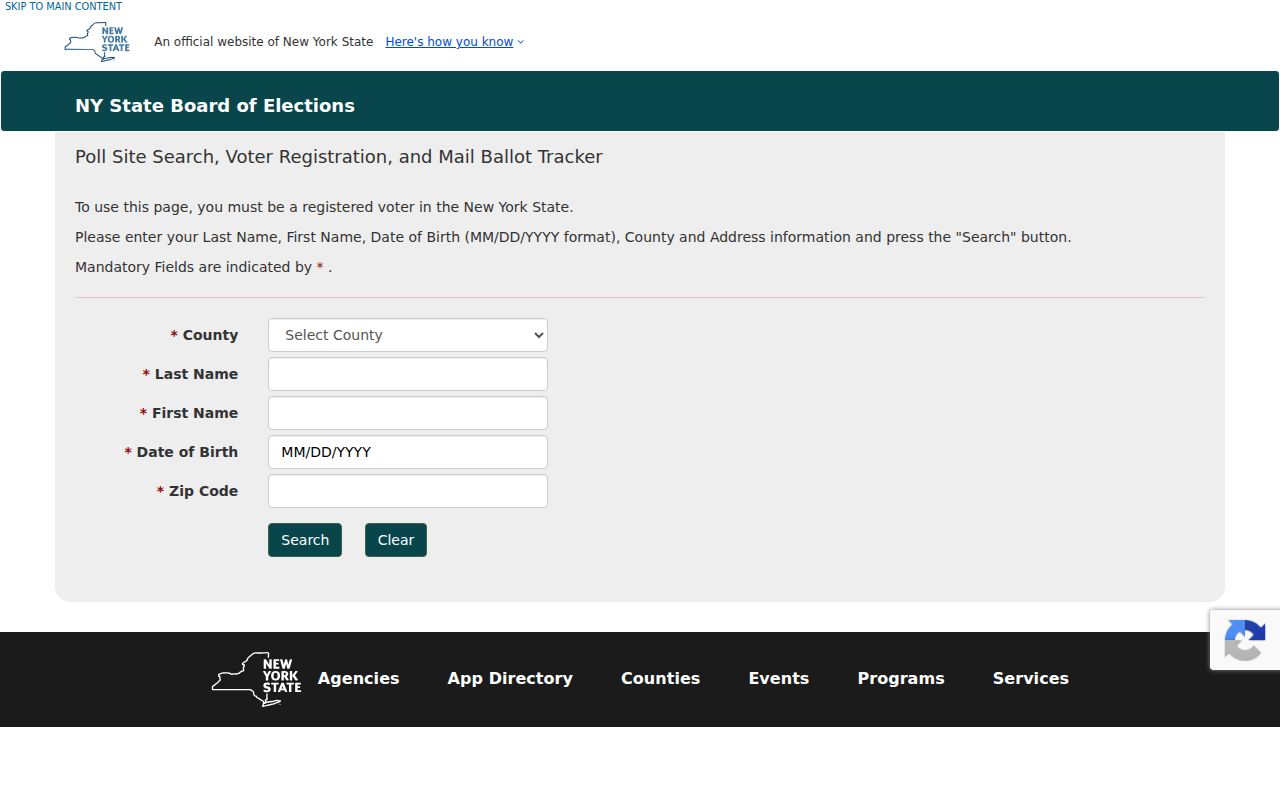
The official New York voter lookup asks for county, last name, first name, date of birth, ZIP code, and address information. It is intended to confirm a registered voter’s own registration, polling place, or related status. It is not a public name-only Camillus residents directory and it does not offer an inspected street-by-street browse tool. The live result fields were not captured in the research, so the prudent approach is to use only the published form requirements and confirm questions with the Board of Elections.
Election Law §3-103(5) restricts voter-registration data to election purposes. A request for voter data must include the required election-purpose statement. Election Law §5-508 also separates qualifying confidential registrations from public inspection for the protected period. Those rules matter when an address or a missing search result looks tempting to overread.
The state lookup form shows the identity fields the system asks a voter to supply.
Use the returned official response as one carefully dated source. A parcel, deed, historical directory, or court entry answers a different question and needs its own date.
Camillus Court Names and Case Dates
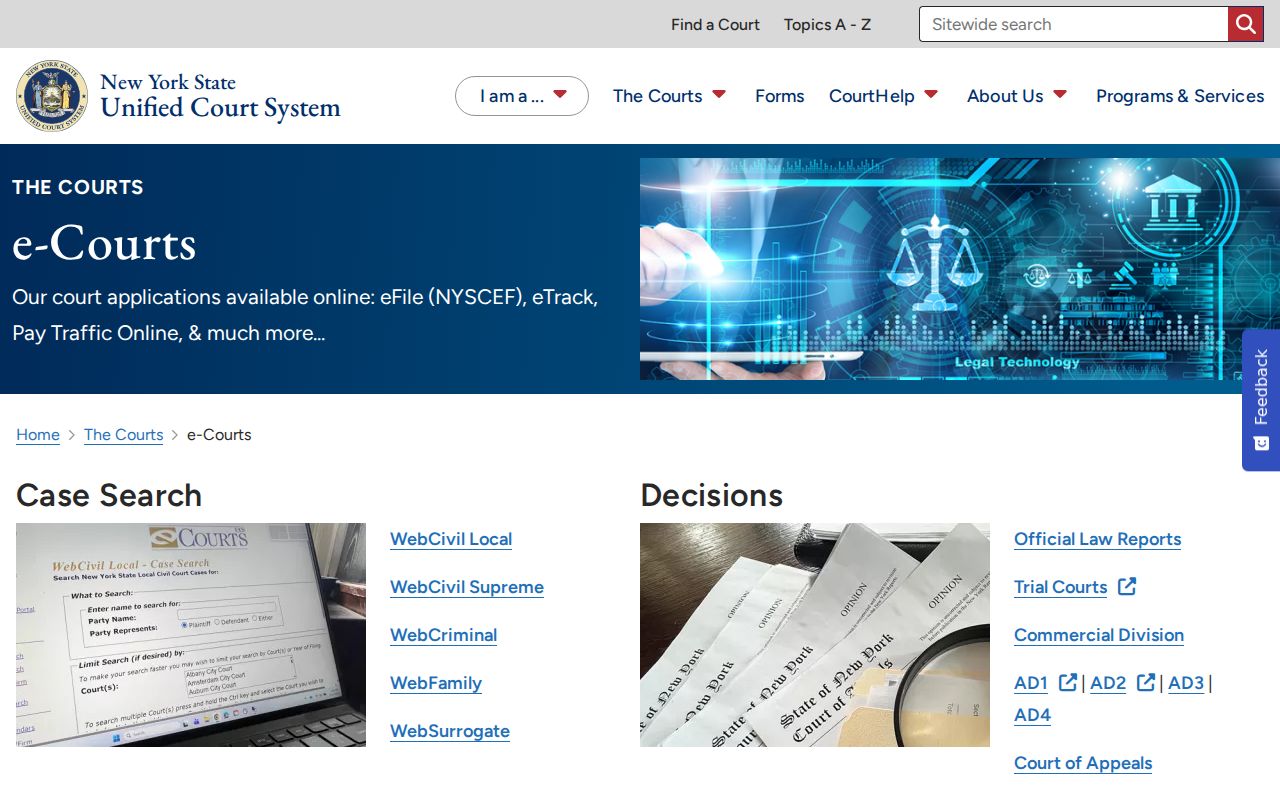
The statewide eCourts gateway links WebCivil Local, WebCivil Supreme, WebCriminal, WebFamily, and related services. Camillus Town Court, the Onondaga County courts, the Supreme Court, and Surrogate’s Court hold different matters. A party name can identify a plaintiff, respondent, attorney, witness, or a similarly named person. Compare the court, index or case number, case type, and dates before treating a result as a person match.
Some files are sealed or protected, including categories involving youthful offenders, adoptions, certain family matters, and other confidential proceedings. An absent web hit does not establish that no court file exists. The responsible court clerk is the route for a full-file question, and NYSCEF guest search can show eligible e-filed Supreme Court documents without an e-filing account.
The NYS eCourts search gateway groups the public search products and their access routes.
A case number, party role, and appearance date make a stronger research note than a bare name match. Ask the court clerk what the index covers when the record matters.
Historical Camillus Resident Directories
The historical shelf belongs at the Onondaga County Public Library Local History/Genealogy department, Central Library, 447 South Salina Street in Syracuse. Its Syracuse and suburban directory run includes selected microfiche for 1844-1862, microfilm for 1862-1935, and print directories from 1936 to the present. Catalog-level gaps and publishers must be checked before a volume is cited. Staff can help with family-history questions but do not build an entire family tree for a patron.
For an earlier rural clue, the digitized Hamilton Child 1868-69 county directory lists Camillus people by name, post office, lot, occupation, and sometimes acreage. Its parenthetical Camillus post office and lot number are historical locators, not a modern street address or parcel number. The fuller collection details and household-tracing method are kept in the Camillus city directory collections.
Camillus Vital and Obituary Trails
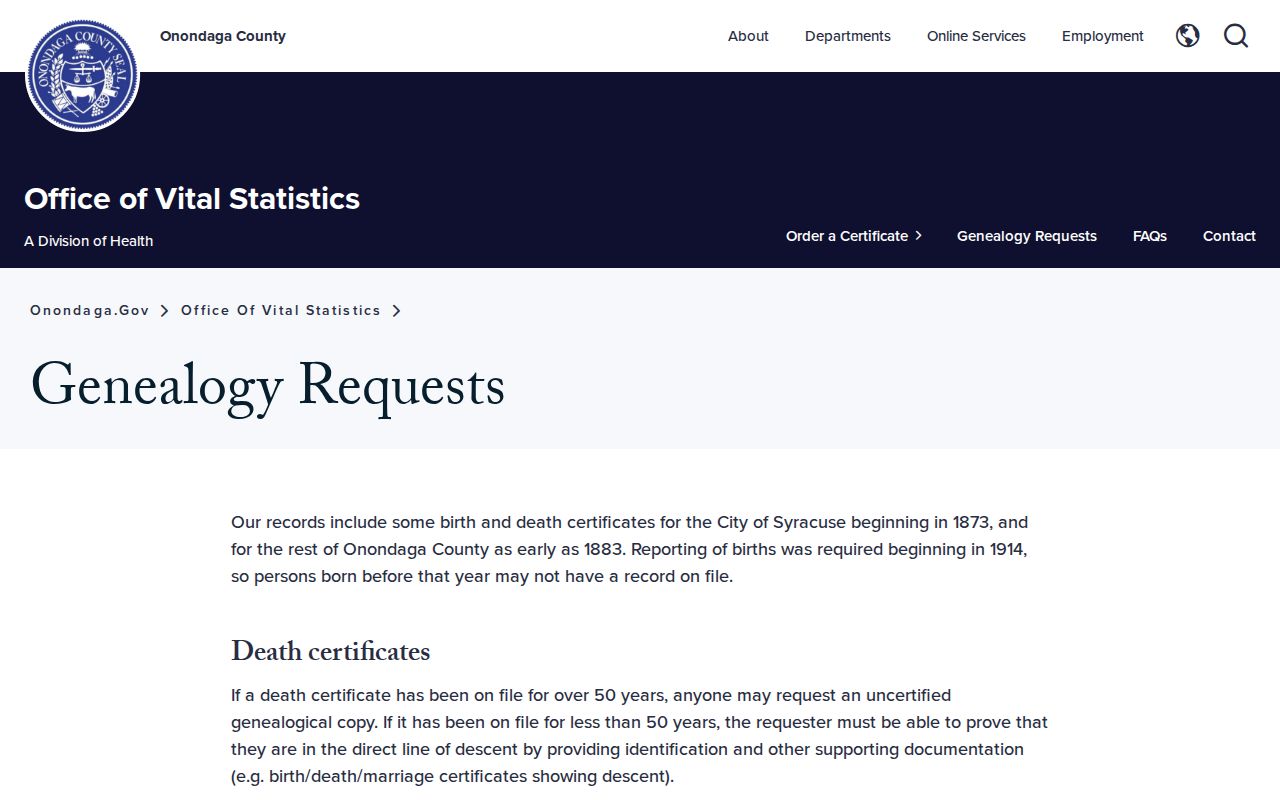
Older family research often needs a date before it needs a certificate. The Onondaga Vital Statistics genealogy route handles local birth and death research by mail or in person. OCPL’s local index can help establish whether a record exists, with marriage and death index coverage from 1881-1964 and birth coverage from 1881-1937. The county directs researchers to the library first for that reason. Eligibility for a copy depends on record type, age, and relationship under county and state rules.
County guidance states that an unrestricted genealogy request can generally reach a birth record after 75 years when the person is known deceased, a death record after 50 years, and a marriage record after 50 years when both spouses are known deceased. The local route posts an eight-week processing note and graduated search charges. Statewide rules and direct-line waivers can be different paths, so use the current official form for the exact request.
The county genealogy instructions show the request method, fee schedule, and timing notes.
An obituary, cemetery entry, directory listing, and vital index may complement one another, but each must remain dated and source-specific. A public index points to a record; it is not the certificate itself.
Camillus Postal Lines and Town Limits
Camillus records need a geography check. ZIP 13031 is the principal postal starting point, but some Town of Camillus locations use a Syracuse 13219 mailing line. The town, villages, hamlets, school districts, parcels, and postal zones are different fields. A Syracuse mailing line on a record does not by itself move the parcel or person into the City of Syracuse.
The county’s ZIP-boundary map is explicitly generalized and is not an official USPS map. Use the USPS address lookup for the delivery ZIP and postal city of a specific address. Then retain the legal town, county, parcel identifier, and source date alongside it. This small audit avoids a common Camillus mismatch before it spreads across a family or street search.
Note: A ZIP is delivery geography, so it can orient a search without proving municipal residence or household membership.
Camillus Records After the 1829 Fire
Camillus has a real break in its local record story. The Town says an 1829 fire destroyed its first 20 years of records. That does not erase early residents from all sources. County deeds begin in 1794, while church and cemetery material, census schedules, newspapers, maps, and family files can rebuild an earlier trail. The right conclusion is a records gap, not a claim that nobody can be documented before the fire.
The Town’s history also places Fairmount, Amboy-Belle Isle, Warners, the Village of Camillus, Nine Mile Creek, the canal, railroad, and trolley within the area’s record geography. A name may appear under a hamlet, post office, lot, or corridor rather than a modern address. The 1874 maps and 1940 Sanborn sheets answer different map questions and work best beside deeds and dated directories.
Camillus Directory Sources and Privacy
A good Camillus residents directory result identifies its source, date, and limitation. Official records offer a custodian, correction route, and clear scope. Commercial people-finder categories may combine stale marketing data, user-contributed information, and unrelated same-name profiles. They are not a substitute for the agency, clerk, or library record that created the underlying entry.
| Source-first research | Compiled people-search category |
|---|---|
| Shows a record type, custodian, and record date. | May combine records with different dates and matching logic. |
| Lets a researcher seek correction from the office that holds the record. | May not show how a profile was merged or refreshed. |
| Supports a narrow question about a parcel, filing, or historical household. | Can obscure the distinction between owner, occupant, party, and relative. |
New York’s Address Confidentiality Program provides a substitute address and mail forwarding for qualifying participants. Voter confidentiality, sealed court material, protected victim data, and recent vital records have their own rules. When an office withholds a field, that boundary is part of the answer.