
Camillus Historical Directory Shelves
Camillus does not have one uninterrupted municipal directory series. The strongest historical shelf is the Onondaga County Public Library Local History/Genealogy Department, which holds Syracuse and suburban directories in several formats. Search the Camillus name alongside Camillus village, Fairmount, Amboy, Belle Isle, Warners, West Genesee, Nine Mile Creek, and Syracuse postal wording. A result under one label is useful evidence, but it does not make the labels interchangeable legal jurisdictions. The online collection statement does not list a publisher for every Syracuse and suburban annual volume, so inspect the title page before recording a publisher in research notes.
| Collection | Years | Where Held | Access |
|---|---|---|---|
| Syracuse and suburban volumes | 1844-1862 selected microfiche | OCPL Local History/Genealogy | Ask staff for the microfiche and relevant place heading. |
| Syracuse and suburban volumes | 1862-1935 | OCPL Local History/Genealogy | Microfilm; annual gaps require title-level checking. |
| Syracuse and suburban volumes | 1936-current | OCPL Local History/Genealogy | Print volumes; ask whether a reverse or address volume exists. |
| Hamilton Child Gazetteer and Business Directory | 1868-69 | New York Genealogical & Biographical Society digital collection | Digitized images and PDF, with a Camillus section. |
| Onondaga county histories and directory books | Collection-specific | NYG&B, OCPL, and OHA holdings | Digital and reading-room access varies by title. |
The table separates a directory run from a resident roster. These volumes commonly carry a name, address, and occupation, yet a given year can be absent from the shelf or may simply index the household under a different local label. The Hamilton Child book is especially useful for rural Camillus because it carries a post office and lot information. It is a county directory, not a modern city-address database.
Note: Preserve the exact directory title, publication year, page, and printed place label before comparing it with a current Camillus address.
Camillus Directory Room Access
OCPL Local History/Genealogy is on the third floor of the Central Library, 447 South Salina Street in Syracuse. Its posted hours are Monday, Thursday, Friday, and Saturday from 9:00 a.m. to 4:45 p.m.; Tuesday and Wednesday from 9:00 a.m. to 7:15 p.m.; and closed Sunday. A valid OCPL card is requested, and nonresidents can obtain a card at the first-floor Welcome Desk. The department answers focused questions about people, places, and events, but it does not construct an entire family tree for a patron.
For a remote request, send one surname, two or three focused questions, a date range, and the locality. Include a given name, approximate life events, spouse or children, and occupation when known. Requests may go by email, telephone, or U.S. mail. That small amount of context helps a staff member distinguish a likely Camillus household from the many similar names in Syracuse and county records.
OCPL’s Local History/Genealogy information documents the room, contact details, and research scope. The room also provides a route to complete 1855 and 1865 New York State census microfilm, even though the online town indexes are partial. That makes a directory entry a starting point for a household, not the end of the search.
The OCPL Local History/Genealogy department page documents the research room used for Camillus directory work.
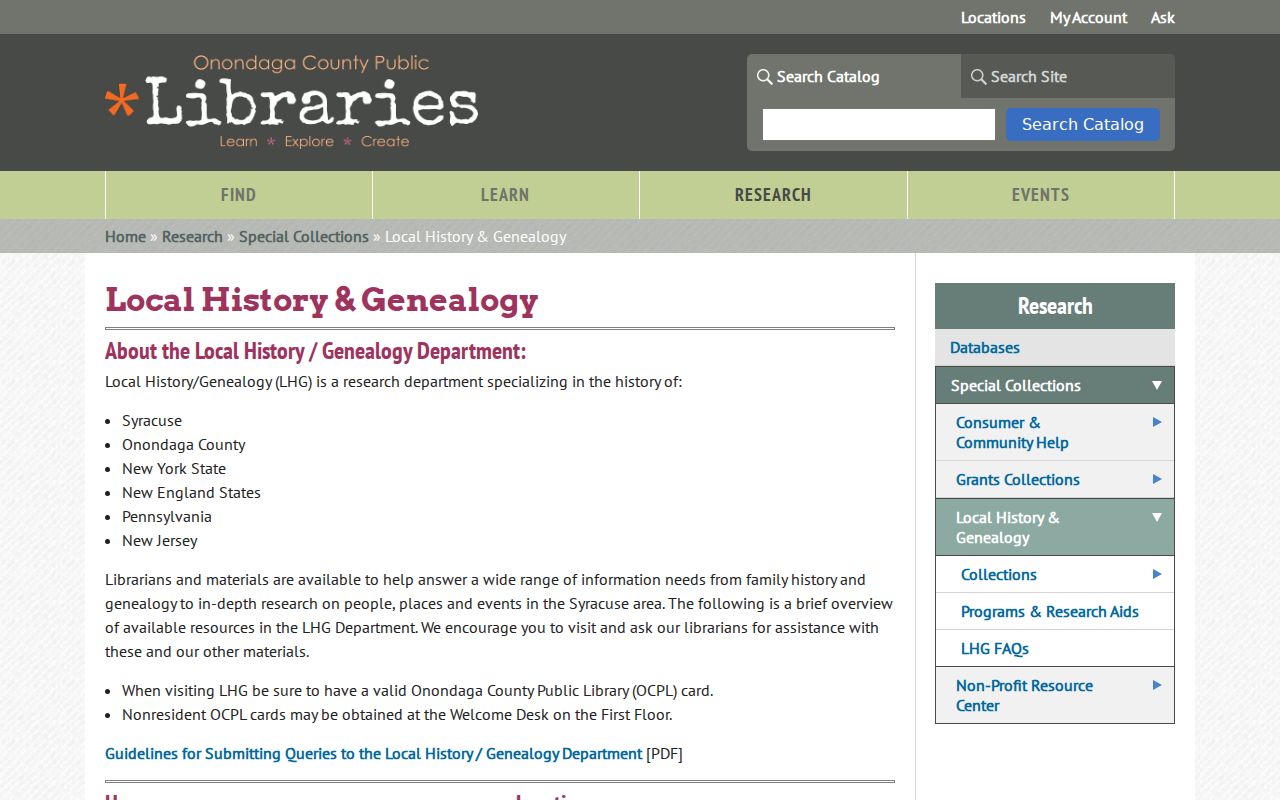
The local-history room is the practical bridge between a directory title and the supporting census, obituary, newspaper, and family-file materials that can confirm a Camillus name.
Reading Camillus Directory Entries
Read the introduction and abbreviation key before extracting a name. Later Syracuse and suburban volumes can put a household in street order or use compact initials and marks. The 1868-69 Hamilton Child volume uses a different rural pattern. Its stated order is the individual or firm name, the post-office address in parentheses, a farmer’s lot number, and business or occupation. A star denotes an advertiser, figures after a farmer’s occupation show acres owned or leased, and capital letters mark subscribers.
| Name or firm | Copy the surname, given name, initials, and spelling exactly as printed. |
|---|---|
| Post office or address | A town, hamlet, rural post office, or street clue; it may not match a modern postal line. |
| Lot reference | For a rural entry, a historical lot clue that needs a map or deed bridge. |
| Occupation or business | A distinguishing detail that can separate two people with the same name. |
| Marks and figures | Check the volume’s key for advertiser stars, subscriber capitals, acreage, and other notation. |
- Criss-cross directory
- An address-order section that lists entries by street rather than by surname. Ask OCPL staff whether a relevant reverse or address volume is held.
- Householder index
- A finding arrangement centered on the household or address, useful when a surname search is incomplete or a street is known.
- Abbreviation key
- The explanatory list near the front of a volume. It defines the short forms and symbols used in that specific edition.
The Child entry “Abbott, George, (Camillus,) lot 64, farmer 40” illustrates the method. It identifies a name, Camillus post office, lot 64, farming, and 40 acres. It does not name every person in the household, and the lot cannot be treated as a present-day tax parcel without a map and deed comparison.
Hamilton Child’s Camillus Record
The New York Genealogical & Biographical Society collection digitizes Hamilton Child’s Gazetteer and Business Directory of Onondaga County, N.Y., for 1868-9. The Camillus section begins on page 143 of the PDF identified in the research. This printed source is valuable because a person becomes more than a bare surname: post office, lot, occupation, acreage, advertising, and subscriber status may all be visible.
The book should be read as a rural county record. A printed Camillus post office is not a modern street number, and a lot number is not automatically an SBL or current parcel. Pair a promising entry with Sweet’s 1874 atlas, county land-ownership maps, deeds, cemetery material, and the 1870 federal census. Those sources test whether a historic lot, road, or household is genuinely connected to the same Camillus place.
The Town’s Camillus Historical Society page identifies the local family-history, photo, and map resources behind this directory lead.
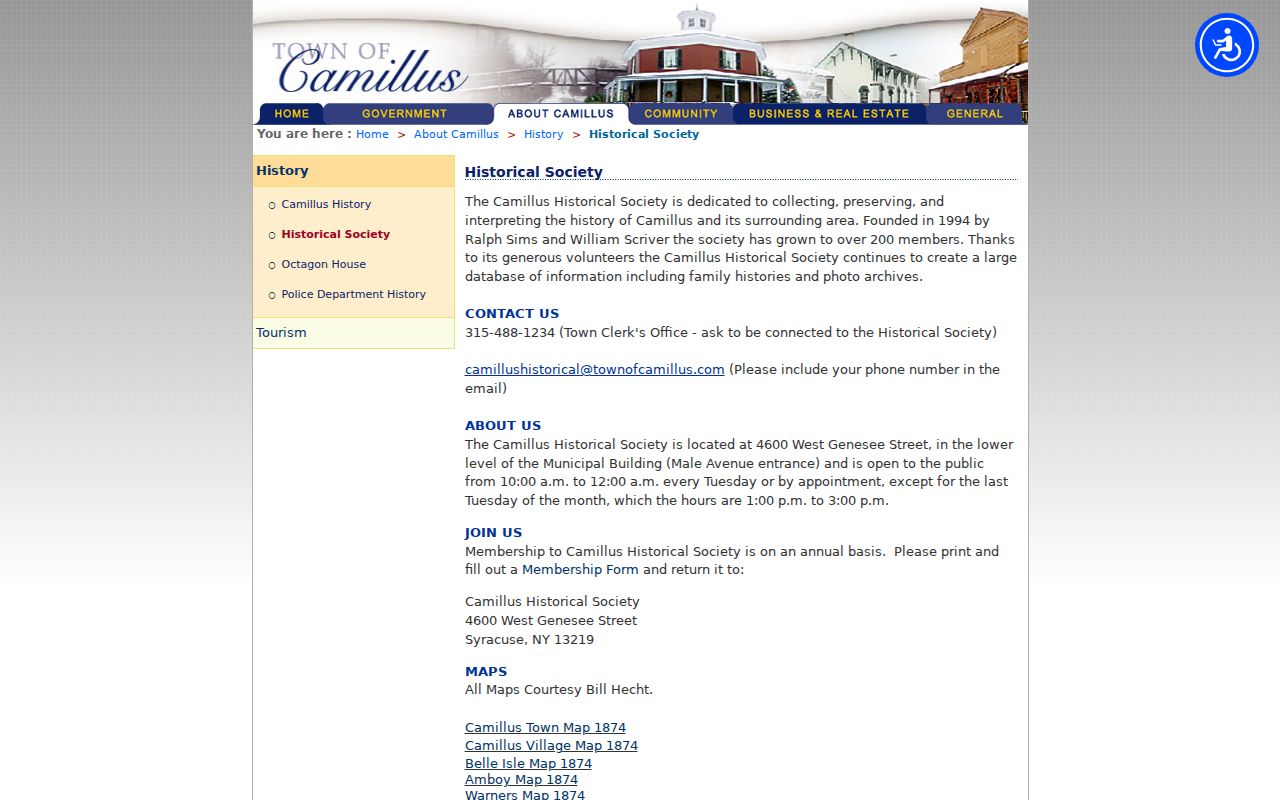
The Camillus Historical Society’s family-history and photo database, along with its 1874 maps for Camillus Town, Camillus Village, Belle Isle, Amboy, and Warners, offers a local map bridge for directory clues.
Note: A name missing from the 1868-69 volume means only that it was not found under the searched spelling and post office in that book.
Camillus Directory Household Years
A household trail should move one year at a time and keep the directory’s own language. Address shifts, initials, spouse notation, and occupation changes help decide whether two entries belong to one family. The Camillus previous residents resource takes over when the question becomes the backward history of one address rather than the directory collection itself.
- Begin with the newest usable volume entry and record the exact spelling, initials, address, spouse notation, occupation, and telephone information where printed.
- Move backward through the directory years. When a street entry disappears, try the town, village, post office, rural route, former label, and nearby Syracuse suburban volume.
- Treat the 1936-current print run and the 1862-1935 microfilm run as different access formats. An unavailable year may be a collection gap, not proof of a move.
- Pair directory snapshots with the 1930, 1940, and 1950 federal censuses, then with the 1855 and 1865 New York State census material when the period fits.
- For an 1868-69 rural name, compare the lot and post office with the 1874 atlas, county tax maps, and deeds rather than assigning it a current parcel number.
- Close a likely household trail with obituary, necrology, probate, cemetery, and County Clerk deed-transfer evidence as the records support it.
Census schedules add household composition, birthplace, and a date-specific residence. Directories provide the between-census address and occupation thread. Neither source alone resolves every name collision. A strong match uses several clues, such as the same spouse or household, place label, occupation, lot or parcel connection, and a date that makes sense.
Camillus Directory Gaps After Fire
Camillus’s record story has a real break: the Town says an 1829 fire destroyed its first 20 years of records. The loss does not prove that an earlier person cannot be documented. It changes the search plan. County deed records begin in 1794, while church, cemetery, census, newspaper, map, directory, and family-file sources can reconstruct parts of an early resident trail. Keep the source date and geographic label with every finding because old post offices and modern municipal boundaries do not always align.
OCPL adds useful scale to that reconstruction. Its partial 1855 New York State census index has 5,432 records and its partial 1865 index has 8,143, while complete county microfilm is available in Local History/Genealogy. The WPA newspaper card index lists 52,882 items from 1814 through 1900. Those counts describe collections, not a count of Camillus residents, but they show why an old directory lead can branch into much richer local evidence.
A practical sequence is 1794 county deeds, the 1868-69 Child directory, 1874 map material, census records, and later printed volumes. The sequence has gaps. It is still more defensible than assuming a surviving town register follows every Camillus resident continuously from the town’s founding.
Camillus Directory Collection Partners
The Camillus Historical Society is in the lower level of the Municipal Building at 4600 W. Genesee Street, with the Male Avenue entrance. Its Town-hosted page lists a volunteer-built family-history and photo database, historic map holdings, a telephone contact, and Tuesday hours. Because the posted noon notation is unusual, call before relying on the schedule. A society inquiry can be particularly useful when a directory gives a farm, road, post office, cemetery, or local family name rather than a clear street address.
The Onondaga Historical Association Research Center holds family and surname files, photographs, maps, clippings, and local documents that can supplement directory research. Its research-center page reports construction-related closure or limited service, with reopening expected in summer or fall 2026. Check current availability before an in-person visit or remote request. Its collection descriptions are broad, so ask about a surname, place, document type, and date range rather than assuming an item is online.
The OHA Research Center page describes the archive’s maps, local documents, and family-file resources.
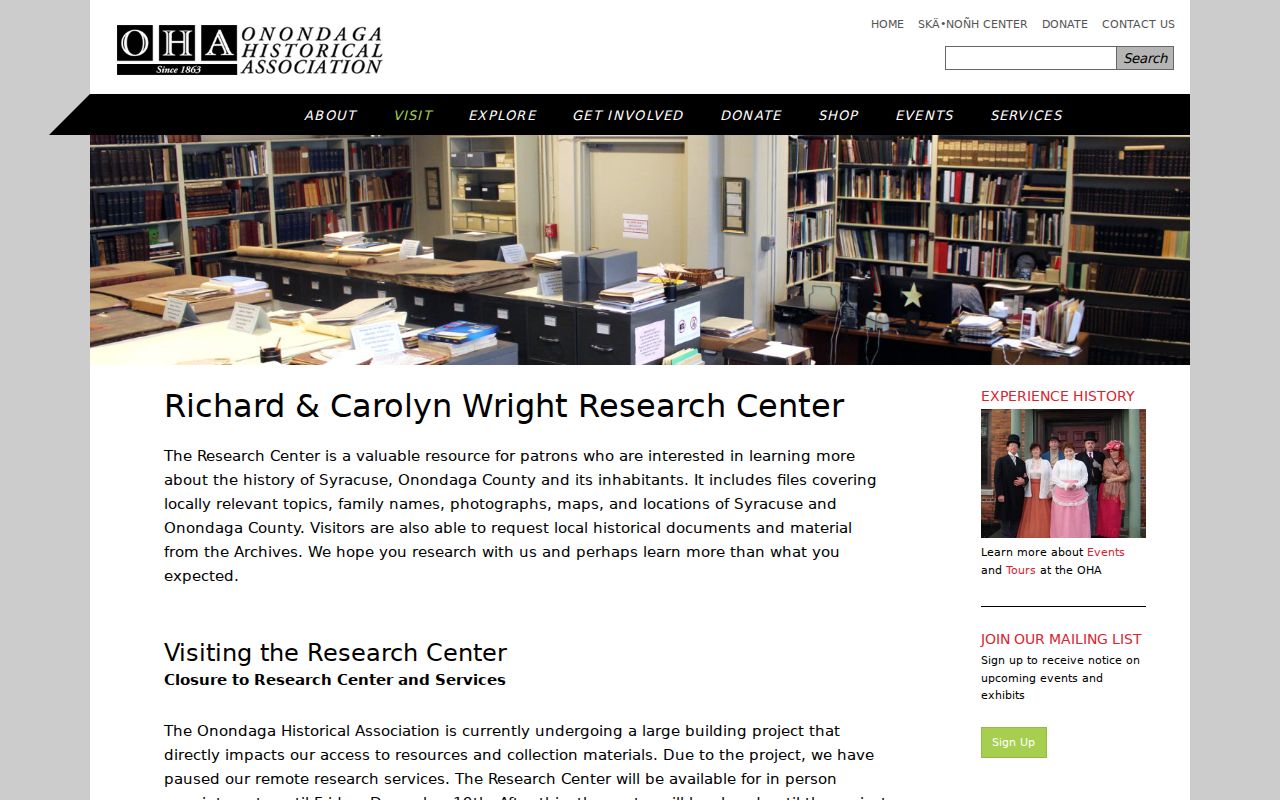
OHA is a supporting archive for Camillus directory work, especially when maps, photographs, clippings, or surname files can test a name found in a printed volume.
Camillus Historical Directory Limits
Directory publications are selective, not a complete roll of every Camillus resident. A household can be omitted, printed under a neighboring urban or postal label, indexed under a different spelling, or absent because a year is missing from the run. A volume can show an address and occupation, but it does not prove legal town residence, parcel ownership, or every household member. Preserve uncertainty rather than forcing an attractive match.
Use independent records for confirmation. The County Clerk can supply a deed trail for land ownership, the assessment layer identifies the assessed owner rather than every occupant, and census records show a household on an enumeration date. For obituary material, OCPL’s obituary index spans about 1860-1996 and its selective clipping collection spans 1862-1992; staff can advise on a missing-index or later-period search. Research requests work best when they state the person, date range, place, and record type sought.
Note: A directory entry is strongest when its spelling, place label, date, and at least two supporting details agree with independent Camillus records.