
Camillus Resident Lookup Records
One name can appear in several Camillus record systems, but each system answers a narrower question. The county assessment record identifies the person or entity assessed for a parcel and the tax correspondence address. A deed index identifies parties to a recorded instrument. Court search products report selected public case or calendar information. Historical vital and directory material can establish an event or a dated household lead. None is a complete current household list.
| Record | What It Confirms | Where | Access |
|---|---|---|---|
| Assessment parcel | Assessed owner, situs, mailing field, SBL, and roll context | Onondaga RPTS / Beacon | Public search; data can change before the final roll |
| Recorded instrument | Grantor, grantee, recording trail, and document reference | Onondaga County Clerk Cott eSearch | Guest index; images may require an account, subscription, or counter request |
| Case or calendar | Public case number, caption, court, date, and status where available | New York State eCourts | Online products vary; clerk files remain the complete route |
| Voter self-check | A registered voter’s own registration and poll-site response | NYS voter lookup | Individual lookup with required identity fields and election-law limits |
| Vital genealogy index | An eligible historical event lead, date, place, or certificate number | Onondaga Vital Statistics | Age, relationship, fee, and processing rules apply |
For a current parcel question, begin with RPTS or the County Clerk. For an older family question, begin with the vital or library path. Use a court record only when a case, court, or date gives a meaningful connection. A source result should be recorded with its date and the exact place label, because a Syracuse mailing line can coexist with a legal Town of Camillus record.
Camillus Resident Name Checks
Before searching, make a short identity ledger. Preserve the supplied spelling, middle initial, suffix, married or former surname, date range, and locality. Then add only a second identifier supplied by a source: a spouse or parent, a parcel SBL, a post office, an obituary relationship, a court and date, or an organization. A ZIP is weak evidence here. Postal labels such as 13031 and 13219 can cross the assumptions people make about the legal municipality.
Run exact and variant searches separately. In a Cott result, retain the book or page reference and instrument date. In a court result, retain the case or index number and party role. In a directory or vital index, retain the page, certificate number, event place, or printed locality. Mark a no-result with the spellings and years searched. It is much safer than treating a common-name match as proof.
Camillus Family Record Gaps
Camillus has an important local break in its record story. The Town says an 1829 fire destroyed the first 20 years of town records. A family may still be documented through Onondaga County land books, which begin in 1794, as well as census material, church and cemetery evidence, maps, newspapers, the Camillus Historical Society, OCPL, or the Onondaga Historical Association. The fire explains a gap in town material. It does not prove that an early resident left no trace.
The 1868-69 Hamilton Child directory offers a useful later starting point because it can place a person by post office, lot, and occupation. Pair that printed clue with a census, deed, map, or obituary rather than assuming the name alone identifies the right person. This slower family-history method creates a dated trail without turning an old address into a claim about a living person.
Camillus Resident Court Search
The eCourts gateway separates WebCivil Local, WebCivil Supreme, WebCriminal, WebFamily, and NYSCEF guest search. WebCivil Local and WebCivil Supreme can show current or disposed case information and calendars where the product has it. WebFamily’s documented routes include file or docket number, attorney name, and law-firm name. The Fifth Judicial District court finder can narrow by case type, court type, county, and a Town and Village Courts control.
| Search product | Choose WebCivil Local, WebCivil Supreme, WebCriminal, WebFamily, or NYSCEF guest search first. |
|---|---|
| Case or index number | The strongest locator. WebCivil Supreme may require the number and county. |
| Party name | Availability and exact-match behavior vary by product; read the party role in the caption. |
| Court or county | Use Onondaga where the product supplies a filter; court-finder has a county filter. |
| Date or calendar | Calendars can be searched by court, location, and date when that route is available. |
| Result action | Find Case(s), Search, Show All Appearances, or Search as Guest opens the relevant result path. |
The eCourts screen shown here is the state gateway for these distinct products.
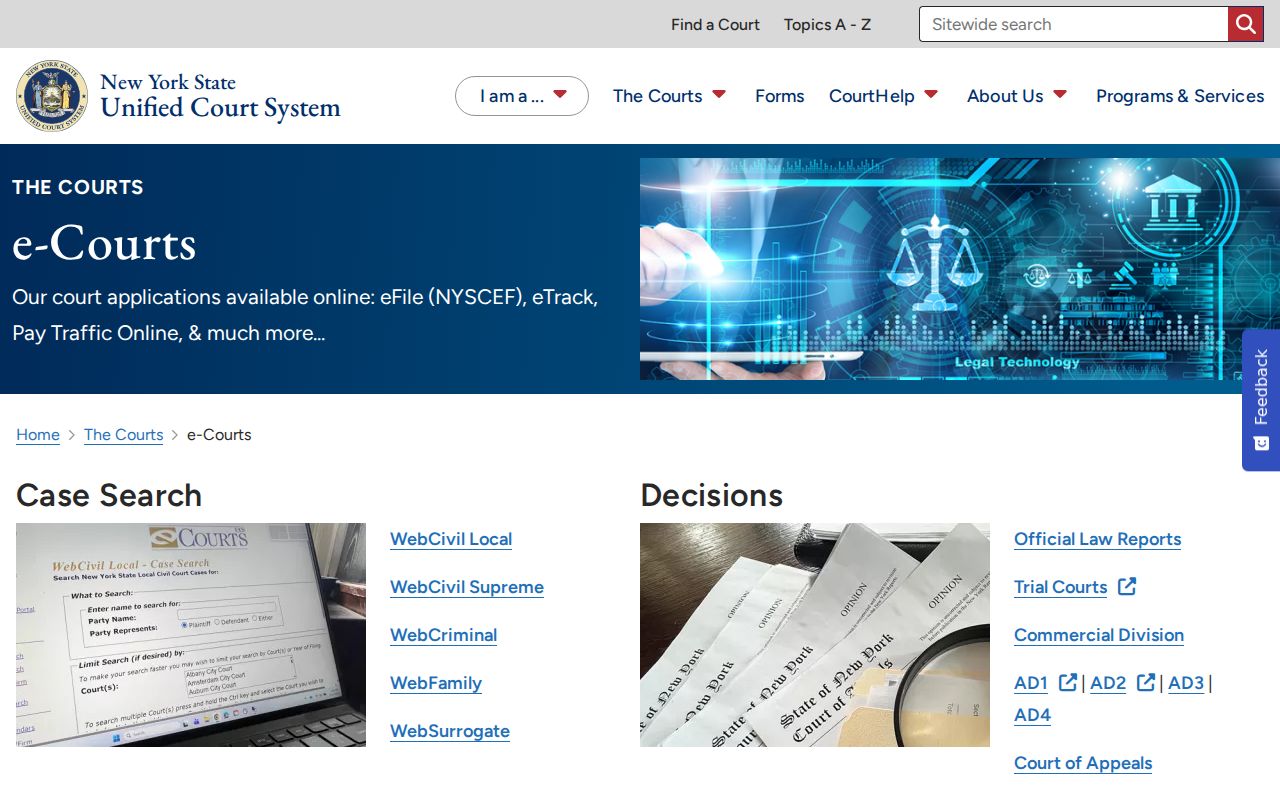
Choose the product that matches the case and keep the court, county, and retrieval date with any result. Camillus Town Court has no dedicated public party-name portal identified in the research, so its clerk is the direct route for local proceedings.
Camillus Lookup Result Details
A public eCourts or NYSCEF result may show a case or index number, case caption and party names, court, county, part, assigned judge, filing or appearance dates, case type, and status. Where supported, a result can also lead to appearance history or eligible e-filed documents. These fields establish the shape of a public case, not a complete biography of a named person.
| Case or index number | The principal locator for clerk follow-up and a county-linked Supreme Court index search. |
|---|---|
| Caption and role | Identifies whether a name appears as a plaintiff, petitioner, defendant, respondent, attorney, or another listed party. |
| Venue and dates | Connect the record to the court, county, calendar, filing, or appearance sequence. |
| Status and documents | May indicate a current or disposed matter and, in eligible NYSCEF files, documents available to a guest search. |
Absence on the web is not a no-record finding. Sealed matters, youthful-offender records, adoptions, Article 81 material, cases not yet entered, and other protected records may not appear. For a matter that affects a family history or estate question, contact the correct court clerk with the name, case number if known, and approximate date. The County Clerk is a custodian for certain records, but it does not schedule hearings.
Camillus Town Court handles local proceedings at 4600 W. Genesee St., Syracuse, with separate clerk phone lines for A-K and L-Z names. Onondaga County Court handles criminal matters at 505 S. State St.; Supreme Court handles civil matters and other specified cases at 401 Montgomery St.; and Surrogate’s Court handles wills, estates, guardianships, and probate at the same county-courthouse address. Use the court and case type to choose the clerk channel, not the person’s name alone.
Verify a Camillus Resident
Use a source chain, not a single hit, to look up a resident accurately. Start with the record closest to the question, then require a separate point of agreement before merging results. A current RPTS owner is not necessarily every person at a parcel. A name in a court caption may belong to an attorney or a business. A historical directory entry fixes a person to its publication date, not every date after it.
- Normalize the name, record variants, and decide whether the question is about a parcel, a public case, a historical family event, or personal voter registration.
- Search the matching official source. For a parcel, retain the situs, mailing field, SBL, and assessment year. For a recorded instrument, retain the book or page and recording date.
- Find a second source-specific identifier such as a spouse, post office, case date, legal description, or obituary relationship before associating records.
- Inspect the record placement, then ask the custodian about coverage, sealing, copy access, or certification when the result matters.
- Docket
- A court’s organized list of a case’s filings, events, and appearances. A docket number helps the clerk locate the specific matter.
- Index versus image
- An index points to a record through fields such as names, dates, and references. An image is the underlying document or scan, which may have separate access rules.
- Certified copy
- A copy issued by the record custodian with the certification required for the purpose stated by that office. An index listing is not the same thing.
Note: A court, deed, directory, and vital index each use different identifiers, so preserve the identifier rather than replacing it with a guessed current address.
Camillus Resident Voter Limits
The New York voter lookup is an individual registered-voter tool, not a name-only Camillus directory. Its instructions require county, last name, first name, date of birth in MM/DD/YYYY format, ZIP code, and address information. It can help a voter confirm registration, poll-site, or mail-ballot information. Do not reproduce a living person’s full date of birth just because the form uses it for matching.
Voter-registration data has an additional legal boundary. Election Law §3-103(5) limits statewide voter-list use to election purposes, and a voter-data request through the Board of Elections must state that purpose. Election Law §5-508 separately protects qualifying confidential registrations from public inspection or copying for the protected period. The Onondaga County Board of Elections is the proper local contact for registration changes, cancellation, or questions about current polling-place status.
This official form shows the county, name, date-of-birth, ZIP, and address prompts used for an individual lookup.
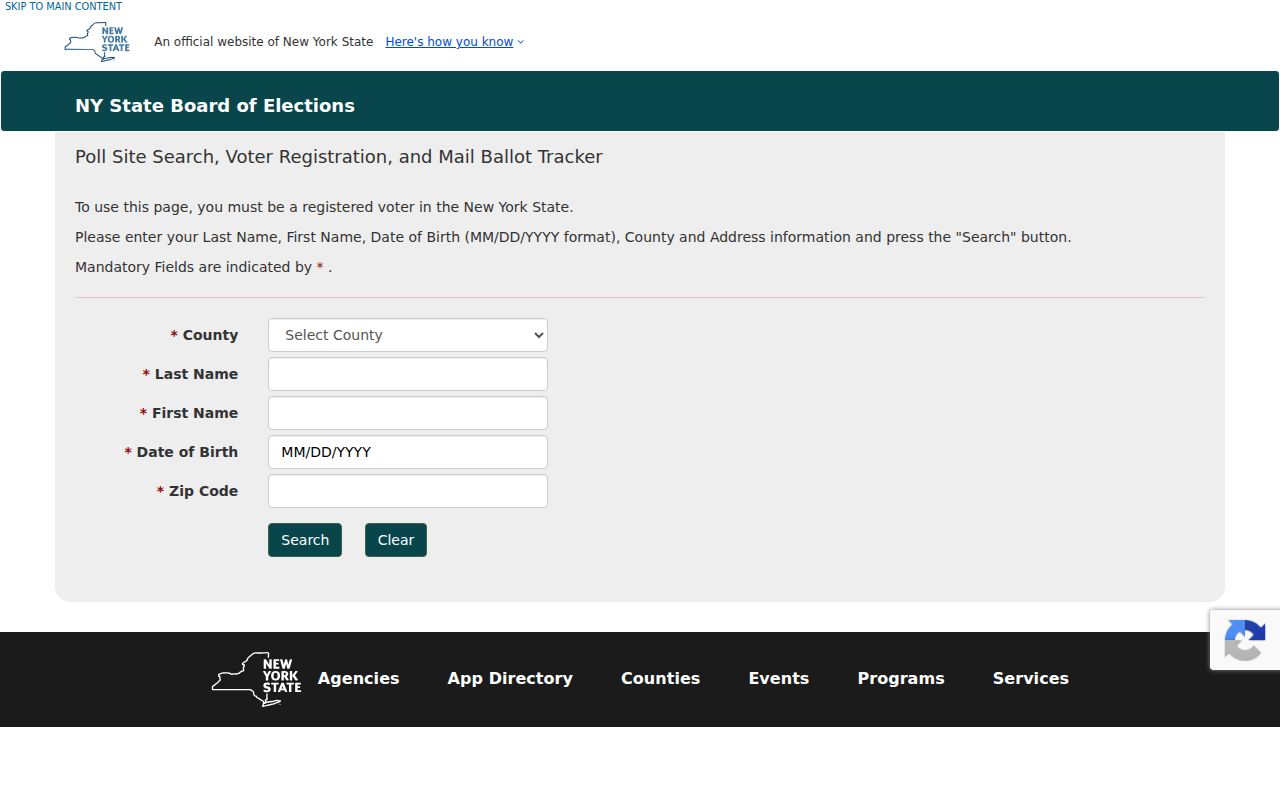
The system does not provide a public browse mode for everyone on a road or for a Camillus block. A missing lookup response should never be used to infer whether someone does or does not live at an address.
Camillus Resident Vital Windows
Vital records are most useful for historical identity resolution. The Onondaga genealogy route serves local birth and death research, while New York State maintains statewide non-New-York-City records and certified-copy functions. Onondaga directs researchers to OCPL’s local-history name index first when possible. Its stated coverage includes marriages and deaths from 1881 to 1964 and births from 1881 to 1937, which can narrow an uncertain request before a fee is paid.
New York’s genealogy rules generally allow a birth record after 75 years when the person is known deceased, a death record after 50 years, and a marriage record after 50 years when both spouses are known deceased. Direct-line descendants may use a waiver with the required relationship and death proof. State archive indexes provide names, event date or place, and a certificate number, but they are not certificates.
Onondaga’s local genealogy instructions show the request path for Camillus and county events.
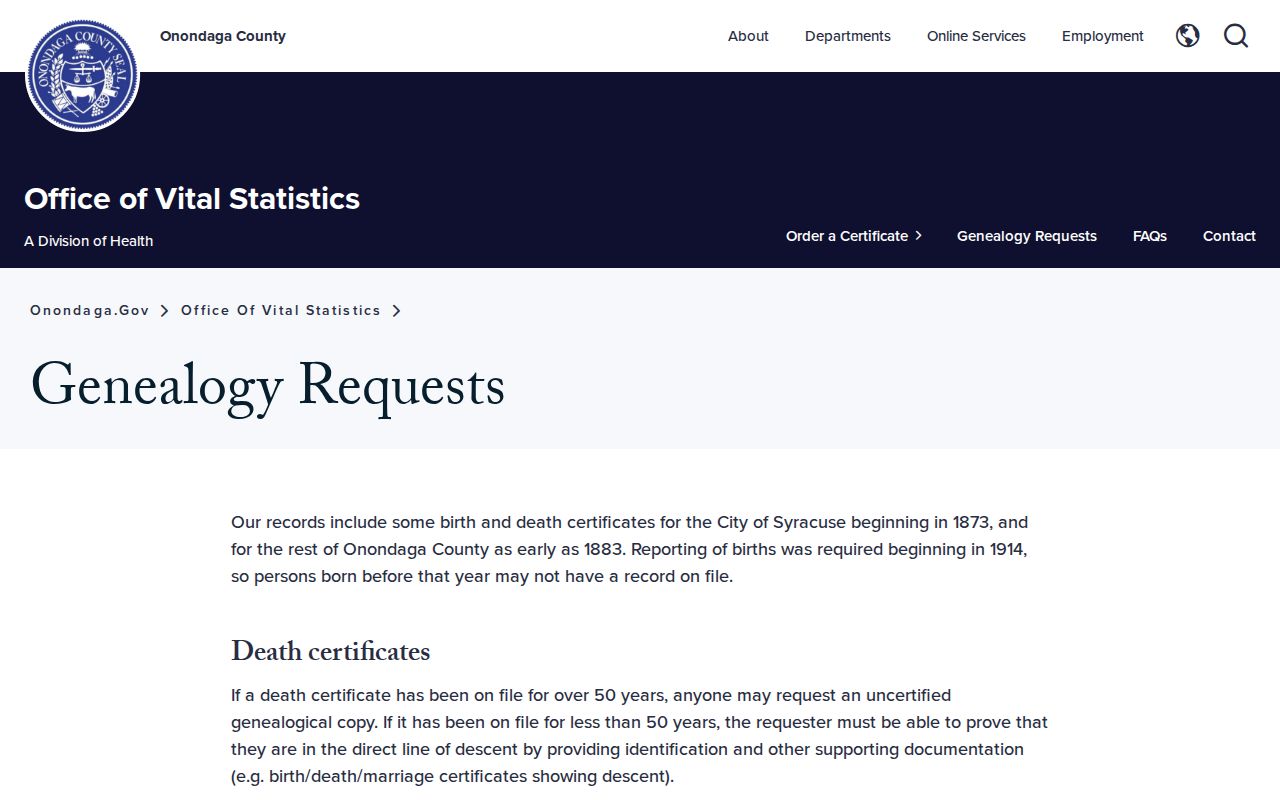
The posted local processing time is eight weeks, with a graduated nonrefundable search fee. For mail-certified copies, the New York State Department of Health lists $30 per copy and regular processing of 10 to 12 weeks. Use the local or state form that fits the event and eligibility rule.
Camillus Lookup Record Requests
When a portal cannot answer a narrow records question, ask the custodian for the existing record. New York’s Freedom of Information Law, Public Officers Law Article 6, begins with access subject to statutory exemptions. Describe the record by name, date range, address, or case reference, and state the preferred delivery method. The Town Clerk handles non-police Camillus requests, while Camillus Police has its own request route. A request cannot require an agency to create a new person list.
Under the published rule, an agency must provide the record, deny access in writing, or acknowledge the request and give a reasonable approximate date within five business days. Standard copies are generally no more than $0.25 per page up to 9 by 14 inches unless another fee applies. A denial may be appealed within 30 days; the appeals officer has ten business days to decide. Court case files follow their clerk and sealing rules rather than a generic request shortcut.
Note: A focused request that names the custodian and record range is more likely to produce a useful response than a request for every item associated with a person.
Camillus Resident Lookup Boundaries
Public access does not erase privacy limits. Sealed court matters, protected victim identifiers, confidential voter registrations, recent or restricted vital records, DMV-linked personal data, and protected addresses remain outside a proper resident lookup. New York’s Address Confidentiality Program uses a substitute address and mail forwarding for qualifying participants. A protected address should not be reconstructed from other records.
Use the minimum data needed for a personal, lawful question. Keep record and retrieval dates, distinguish an assessed owner from an occupant, and ask the actual custodian to correct an error. If a source has only historical value, do not turn it into a claim about a living person’s precise current location.
Lawful use. Camillus resident lookup records support personal research, family history, estate questions, and careful verification. Do not use a record to stalk, harass, threaten, surveil, or harm another person.