
Camillus Previous Residents by Era
Previous residents of a Camillus address are found by matching the source to the period. The current parcel is a good starting point, but it is not a full household list. Preserve the street address, municipality, owner, mailing address, SBL or tax-map number, deed reference, and legal description before moving backward. For older Camillus research, county deeds, directories, census schedules, maps, obituaries, and local files each answer a different part of the question. No single record runs without interruption through the town’s history.
| Source | Years It Covers | Where Held | What It Shows |
|---|---|---|---|
| County Clerk deed and mortgage books | 1794-present county record series | County Clerk and Cott eSearch | Legal owner chain, transfers, and legal description; online cutoff is unverified. |
| Camillus town records | 1799 forward, with early loss | Town, archives, and historical-society substitutes | Local records where they survive; the first 20 years were destroyed in the 1829 fire. |
| Hamilton Child county directory | 1868-69 | NYG&B digitized PDF | Post office, lot, occupation, acreage, business, and rural-location clues. |
| Syracuse and suburban directories | 1844-1862 microfiche; 1862-1935 microfilm; 1936-current print | OCPL Local History/Genealogy | Dated household, street, and occupation clues; annual gaps and labels matter. |
| Federal and New York State census | Federal public through 1950; state runs vary | OCPL, NARA, and approved library hosts | Household composition on the enumeration date, with boundary caveats. |
| Camillus Assessor property cards | Early 1960s-present | Assessor, Image Mate, and Beacon | Parcel inventory, owner and mailing distinction, assessments, and permit-informed changes. |
Start with the source nearest the date you need. For a recent structural change, assessment cards and permit files may help. For an earlier household, use a directory and census together. For a nineteenth-century parcel, deeds and map evidence are usually the stable bridge. The county says its land record series begins in 1794, yet it has not confirmed the beginning year of the searchable online image or index coverage.
Note: An address trail is strongest when each source is dated and the old place label is kept beside the modern Camillus reference.
Camillus Previous Resident Trail
Use Onondaga County Real Property Information, the legacy Image Mate route, or the County GIS to locate the parcel. Official instructions support municipality, owner-name, address, and tax-ID or parcel-number searching. Select Camillus, enter one search item first, then narrow if needed. Record the property location or situs, assessed owner, owner mailing address, tax map or SBL, deed book and page when shown, legal description, and assessment-roll year.
Read those fields literally. The situs is where the parcel lies. The mailing address is where tax notices go. The owner line identifies the assessed or tax-roll owner, not every person who lived at the address. A trust, estate, company, or out-of-town mailing line can appear. Onondaga warns that assessor-supplied property information can change before the final roll and is not guaranteed current, correct, complete, or final.
The Onondaga GIS viewer can search parcels by owner or address, find addresses, measure distance and area, turn layers on at appropriate zoom, and export a map to PDF. It is helpful for saving a parcel context and adjacent roads. It is not a legal boundary survey. A recorded deed, tax map, and licensed survey are the documents for a boundary question.
Camillus Resident Deed Chain
The Onondaga County Clerk is the land-record anchor for Camillus. Begin with the property card, then search the current owner as a grantee in the Cott eSearch index. The purchase deed identifies the prior seller. Search that seller as a grantee to locate the earlier acquisition, then repeat. Each link should be checked against the legal description, lot, block, tract, map reference, and cross-references instead of the house number alone. Addresses can change or may describe only one structure on a larger tract.
- From Image Mate, Beacon, or the Assessor, copy the Camillus parcel’s SBL or tax-map reference, situs, owner, deed book and page, and legal description.
- Search the current owner as grantee in Cott and narrow by deed or instrument type and approximate date. Write down the index reference before obtaining an image.
- Read the acquisition deed when available. Capture every grantor and grantee, recording date, consideration or transfer indicator when displayed, book or document reference, legal description, and any earlier instrument citation.
- Search the grantor as a grantee. Repeat for married-name variants, trusts, estates, companies, corrective deeds, survivorship transfers, estate orders, and related mortgage satisfactions when they belong to the same tract.
- When the online trail stops, ask for the oldest book and page that carries the same legal tract at the County Clerk counter. Older handwritten books may require a counter or microfilm search.
- For each ownership period, use directories, census, newspapers, obituary files, probate, and church material to test who occupied the place.
- Grantor
- The person or entity transferring an interest in the recorded instrument.
- Grantee
- The person or entity receiving that interest. In a purchase deed, this is commonly the buyer.
- Chain of title
- The sequence of recorded transfers used to follow legal ownership of the same tract backward.
- Legal description
- The deed’s formal land description, such as lots, blocks, tracts, or metes and bounds. It is more stable than a street number.
Camillus Cott Index Access
Cott provides free guest viewing of the County Clerk’s index. Available document images require an account or subscription, and not every index entry has an available image. The research did not verify the online cutoff year, so a successful current search should not be presented as proof that all county deeds from 1794 are online. The Clerk confirms that the county series begins in 1794 and that its oldest records are handwritten and difficult to read.
Old names can be indexed with an inserted space. The documented Cott “Contains” approach is useful for a likely name variant. Keep the result date, instrument type, party spelling, and book or page with the search notes. County pages identify deeds, mortgages, easements, court orders, UCC liens, subdivision maps, assignments, releases, powers of attorney, and other recordings as part of the recorded-document system. Their presence does not automatically answer who occupied the property.
The fallback channel is direct: the Onondaga County Clerk is at 401 Montgomery Street, Room 200, Syracuse, NY 13202, telephone (315) 435-2227, with Monday through Friday hours of 8:30 a.m. to 4:00 p.m. The Clerk also handles copies and genealogy or naturalization searches. Use the counter, mail, or a narrow records request when the online index lacks the older book, image, or readable description needed for the chain.
Note: Keep an index reference even when an image is deferred, because it supplies the book, page, date, and name trail for later verification.
Camillus Address Map Bridges
Camillus has no verified town-wide street-renumbering or renaming year in the researched official sources. Do not invent one. Instead, bridge an address by comparing the current GIS or SBL record, the deed’s legal description, the old directory’s rural lot or post-office notation, the 1874 Camillus maps, and the 1940 Sanborn sheets. Agreement across more than one source makes a continuity claim stronger; a current street number alone does not.
The Library of Congress Camillus Sanborn item has six 1940 sheets. It can show a mapped building footprint, material, use, street numbering, and nearby landmarks in the covered area. It does not list every private occupant. The Camillus Historical Society holds 1874 maps for Camillus Town and Village, Belle Isle, Amboy, and Warners. Pair either map with deeds, directories, and census rather than using its labels as a stand-alone ownership answer.
Postal wording requires equal care. “Syracuse, NY 13219” is used for Town of Camillus offices and properties, while Camillus and 13031 also appear. Preserve legal town, village or hamlet, county, postal line, road, and parcel number as separate fields. A parcel may also have been split or combined, meaning an old lot number and current SBL are not necessarily one-to-one.
Camillus Previous Residents as Households
A deed chain identifies legal ownership, not always the people who lived in a Camillus house. The household layer comes from street or post-office entries in OCPL directories, federal and New York State census schedules, newspapers, obituary notices, cemetery files, probate, and church records. The historical volumes themselves are described in the Camillus city directory collections; use them here as dated evidence for a single address trail.
The practical flow is: address or SBL to deed legal description, legal description to an owner period, owner period to directory or census household, and household clues to obituary or probate confirmation. For the rural 1868-69 Hamilton Child record, use the post office and lot with the 1874 atlas, tax maps, deeds, cemetery material, and 1870 census. Never convert its lot number directly into a modern tax parcel.
- Choose a directory year near the owner period and copy the name, initials, spouse notation, printed address or post office, and occupation.
- Move backward or forward by directory year, trying Camillus, village, hamlet, rural-route, and Syracuse suburban labels when the street is missing.
- Pair the directory snapshot with the closest public federal census and, where relevant, the 1855 or 1865 New York State census microfilm at OCPL.
- Use newspaper, obituary, necrology, probate, and cemetery records to test a move, death, spouse, heir, or last address before joining similar names.
A census is a household snapshot on its enumeration date. A directory is a publication snapshot that may fall between censuses. A missing name in either is negative evidence only for that source, year, spelling, and locality.
Camillus House Record Evidence
OCPL’s local-history staff and query guide are the documented library route for a Camillus house file. The library does not advertise a separate house-history service. Ask instead for a focused directory pull, census film, obituary index, local-history file, land-ownership map, or Sanborn material. A good request identifies one surname, a limited period, a locality, and two or three questions. The guide lists no fee for a five-year New York State vital-index search, $5 for each additional five years per name, $5 for five days of newspaper microfilm searching, and copy charges of $0.25 per page plus $1 mailing.
The OCPL additional sources information page identifies the library materials used to reconstruct a Camillus address history.
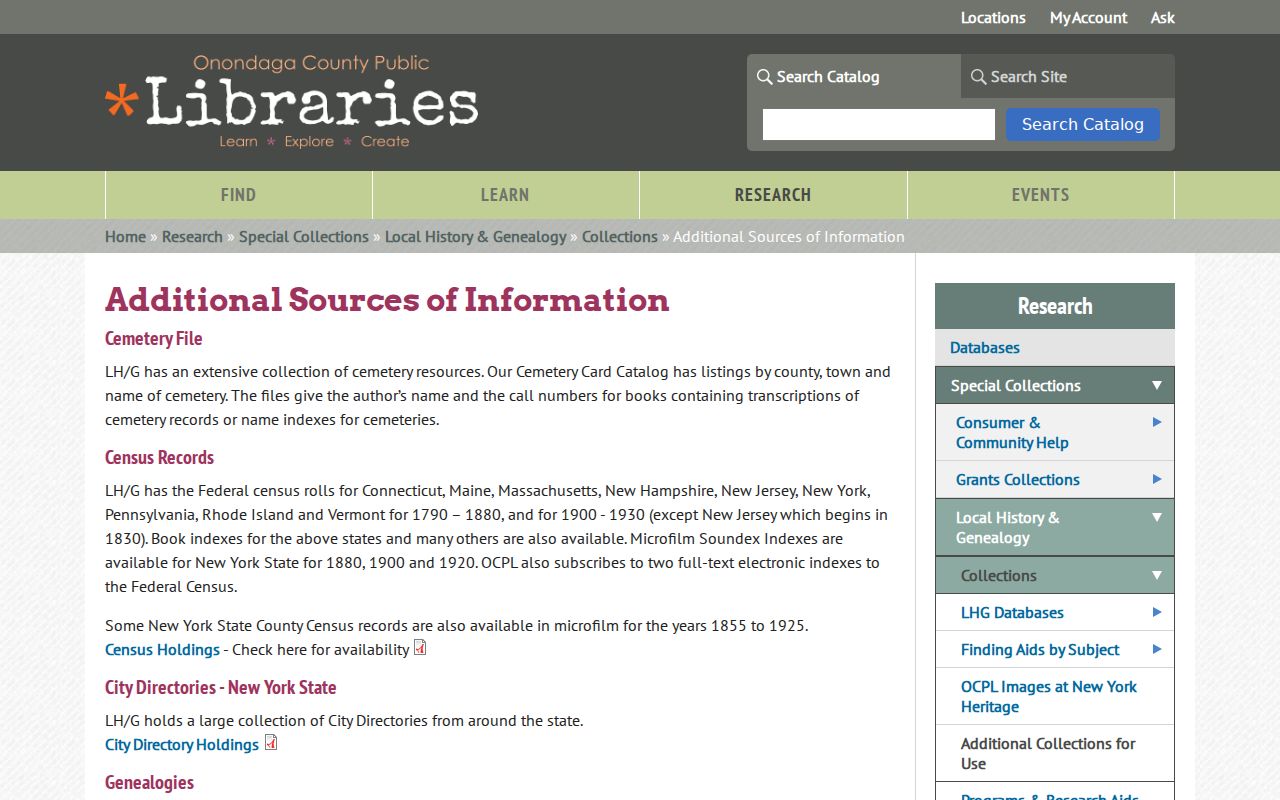
The OCPL materials support a file that combines directory, map, tax, census, newspaper, and local-history evidence instead of treating one search result as a completed address history.
Camillus Assessor property cards add a local property-history run from the early 1960s forward. For building changes, Camillus Code Enforcement can be asked for a permit number, address, applicant or owner, inspection history, certificate of occupancy or compliance, and retention range. The current Cloudpermit route is not documented as a historic public search. Request older material by address through the office and ask about copies, redactions, and retained years.
Camillus Records at Trail Endpoints
When a prior owner disappears from a deed or directory, death and estate records may explain the change. OCPL’s obituary index spans about 1860-1996; its selective obituary-clipping collection covers 1862-1992. Newspaper microfilm extends from 1850 to within three months of the present, with some gaps. Search the decedent, spouse, executor, heirs, and former address, then return to the County Clerk for an estate transfer. A probate file may add relationship clues, but only use what a lawfully available public record displays.
The Camillus Historical Society can search its family-history and photo database and local maps by appointment or Tuesday hours. OHA also holds surname and family files, photographs, maps, and county documents, but its Research Center has had construction-related closure or limited service with reopening expected in 2026. Confirm availability before visiting. These collections are particularly useful after the 1829 fire destroyed the first 20 years of town records, when county deeds and independent local sources must rebuild an early trail.
Note: The 1829 fire explains a town-record gap, not an absence of all evidence for earlier Camillus residents.
Camillus Previous Residents Limits
Use previous-resident research for family history, estate or heir questions, house history, and personal curiosity. Keep historical public material separate from details about living people. Narrow requests to the record and date range needed. A match of names alone is not identity proof, especially where a common name, changed postal label, or changing street address is involved. Record the source date and retrieval date, then correct an error through the custodian rather than silently combining records.
New York’s Address Confidentiality Program uses a substitute address and mail forwarding for qualifying protected participants. Confidential voter registrations and sealed or otherwise restricted records are not a source for an address history. New York FOIL allows access to agency records subject to exemptions and does not require an agency to create a new record. Ask the actual custodian for an existing record, format, and date range, and respect redactions and confidentiality notices.